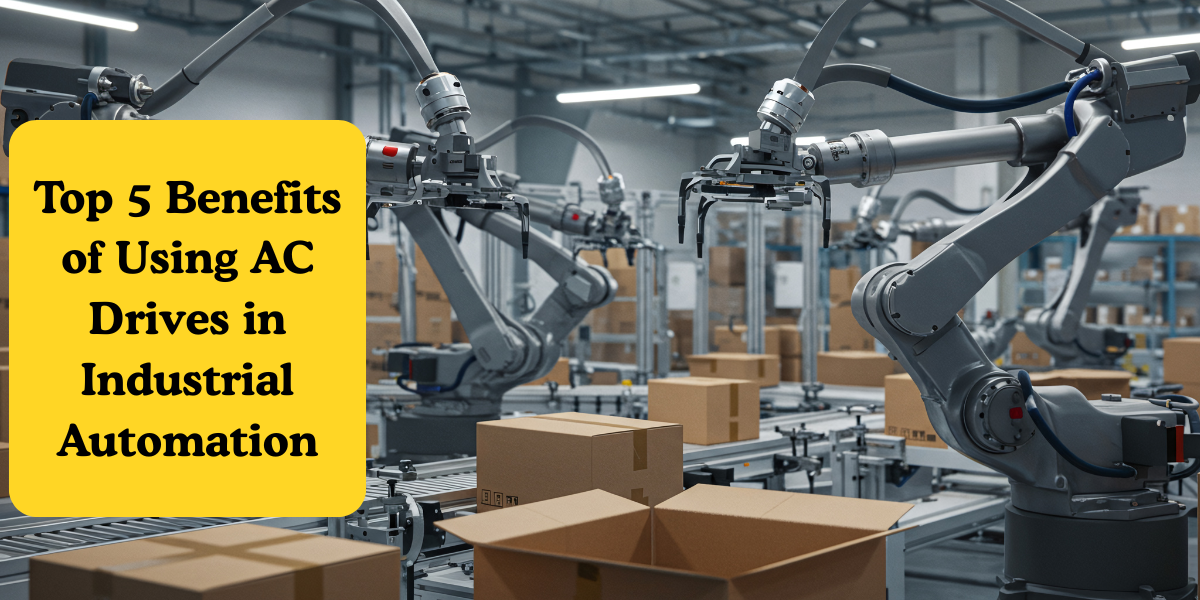
In today’s fast-paced industrial environment, efficiency, precision, and energy savings are crucial. AC Drives—also known as Variable Frequency Drives (VFDs)—play a key role in achieving these goals by controlling the speed and torque of electric motors. Here are the top 5 benefits of using AC Drives in industrial automation:
- Energy Efficiency and Cost Savings
AC Drives optimize motor speed based on load requirements, reducing unnecessary energy consumption. This can lead to up to 50% savings on energy bills, especially in applications like pumps and fans where full speed isn’t always required.
- Enhanced Process Control
By allowing precise speed and torque control, AC Drives ensure smoother operation of machinery. This leads to better product quality, fewer mechanical stresses, and less downtime due to improved accuracy and responsiveness.
- Reduced Mechanical Wear and Tear
Soft starting and stopping provided by AC Drives minimize shocks to mechanical components. This extends the lifespan of motors, belts, and gears, reducing maintenance costs and improving reliability.
- Improved System Protection
AC Drives monitor parameters like current, voltage, and temperature. If abnormalities occur, they can automatically trip or alert the system, protecting both the equipment and personnel from damage.
- Flexibility and Automation Integration
Modern AC Drives easily integrate with PLC, SCADA, and IoT systems, making them ideal for smart factories. They allow remote monitoring and control, enhancing flexibility and operational efficiency.
In the utility-scale solar industry, the primary goal is the relentless pursuit of efficiency. Every single component is judged on its ability to cut financial losses and lower the Levelised Cost of Energy (LCOE). The old standard for AC power collection was around 415V. While this standard was once sufficient, it now presents significant limitations as modern solar farms continue to expand in both physical size and generating capacity.
A fundamental shift is happening across the industry that redefines the economics of plant design: 800VAC. This strategic change creates a chain of benefits throughout the entire electrical system. To design the next generation of high-performance solar power plants, you must understand this transition.
The Technical Challenge with Conventional Voltages
The physics of electrical power transmission are governed by a clear relationship between voltage and current. For any given amount of power, a lower system voltage will invariably result in a higher current. Within the context of large-scale solar farms, where immense amounts of power are collected from hundreds of inverters, this high current becomes a major technical and financial obstacle.
High current is the direct cause of massive resistive losses, or I²R losses. That is valuable energy burning up as wasted heat in your cables, which directly hurts the plant’s efficiency and profitability. To manage this high current, developers have been forced to use thick, heavy, and extremely expensive copper cables, which drives up capital costs and complicates the entire installation process.
The 800VAC Advantage: A More Strategic Approach
By nearly doubling the system voltage to 800VAC, the entire electrical equation is fundamentally altered for the better. For the same amount of power being transmitted, the current is reduced by almost half. This seemingly simple adjustment has profound and positive consequences for the entire plant design.
The most immediate benefit is a significant reduction in I²R losses. Less wasted heat means a greater percentage of the power you generate is successfully exported, providing a direct and measurable boost to the plant’s performance ratio.
Furthermore, the lower current lets you use considerably thinner and lighter cables. This delivers a huge cost saving on copper, one of the biggest material expenses in any solar project. It also simplifies logistics and can help accelerate construction timelines. At the centre of this modern design is the purpose-built 800VAC LV switchgear, which serves as the collection and protection hub.
Key Components in an 800VAC Ecosystem
This higher voltage requires an ecosystem of components built for the job.
- Solar Inverters: It all starts with the inverters. They must be capable of converting DC power into 800VAC power. This technology is already a mature, standard offering from all leading manufacturers and is the foundation of the high-voltage design.
- 800VAC LV Switchgear: This is the critical nexus for power collection and protection. The 800VAC LV switchgear (MCCB ,ACB ,Isolator ,SPD ) is designed to safely manage the output from multiple inverters. A standard circuit breaker is not adequate for this application; Dedicated range of 800Vac Switchgear is specifically rated and certified for 800VAC operation to handle the unique electrical characteristics of solar power generation.
- Medium Voltage Transformers: After the power is collected in the low-voltage switchgear, it is stepped up for transmission to the grid. Utilising an 800VAC input allows for the design of more compact and efficient medium voltage transformers. The higher input voltage simplifies the transformation ratio, resulting in a better transformer design with lower internal energy losses.
The System-Wide Benefits of Integration
Higher voltage cuts the current, which in turn means lower resistive losses, thinner cables, and more efficient transformers. The final result is a solar plant that costs less to build and earns more revenue over its life. This total system upgrade is what makes the 800VAC architecture so powerful.
Final Thoughts
At Lauritz Knudsen, we see that 800VAC is the new standard for any serious utility-scale solar project. This technical evolution requires reliable, purpose-built components designed for optimal safety and performance.
We are at the forefront of this industry shift, providing the robust solutions needed to build the solar farms of tomorrow. Our portfolio is built around advanced 800VAC LV switchgear and the specialised solar MCCB components that form its protective core. Our engineering delivers the reliability that large-scale renewable energy projects need. For your next project, our expertise can help you capture all the financial and operational benefits of this superior technology.